
Loving You Without Losing Me
Making space for your feelings and theirs—at the same time

I didn’t notice it at first.
It was a good day, one of those quiet unexpected ones where nothing extraordinary happened, but I felt… light. My body was softer and my breath came a little easier. There was space inside me.
And then I walked into the room.
Matt was sitting there tense, shoulders tight. Something in his face told me the day hadn’t met him the same way it met me.
I felt it immediately.
Not just that he was off—but something in me shifted too. The lightness I had been carrying… dimmed, my chest tightened just slightly and my mind started scanning.
What happened?
Are you okay?
Should I do something?
And underneath that, quieter but just as present:
Can I still feel good right now?
It’s such a small moment, almost invisible. But it happens to all of us and often goes unnoticed -even though it’s deeply felt.
When someone we love is struggling, our system responds, it’s part of how we’re wired. We’re relational beings: we attune, we mirror, and we take it in.
Your child is overwhelmed, and suddenly your body is buzzing.
Your partner is withdrawn, and your own energy drops to meet them.
A friend is hurting, and your chest carries a weight that wasn’t there before.
Sometimes this is connection and sometimes… it’s something else.
Sometimes, without even realizing it, we slip into a quiet kind of merging. Their emotional state becomes the emotional atmosphere we live inside of. Not because we choose it, but because it feels like the only way to stay close.
I’ve noticed this in myself in different ways.
With Matt - feeling the urge to soften my own experience so I don’t feel out of sync.
With the kids - when one of them is dysregulated, feeling my own nervous system speed up, like I need to match their intensity to help them through it.
Even in small moments - catching myself holding back a smile, or dimming a sense of ease, because someone I love is having a harder time.
It doesn’t look dramatic from the outside but internally, it feels like a quiet contraction. There’s often guilt underneath it, a belief that lives just below the surface:
If I really love you, I shouldn’t feel okay when you don’t.
Or even:
If I stay in my joy, does that mean I’m leaving you alone in your pain?
So, we adjust.
We come down to meet them and take on more than is ours. We try to fix, soothe, manage - anything to close the gap between our experience and theirs.
It can look like care but often it’s disconnection, particularly from ourselves.
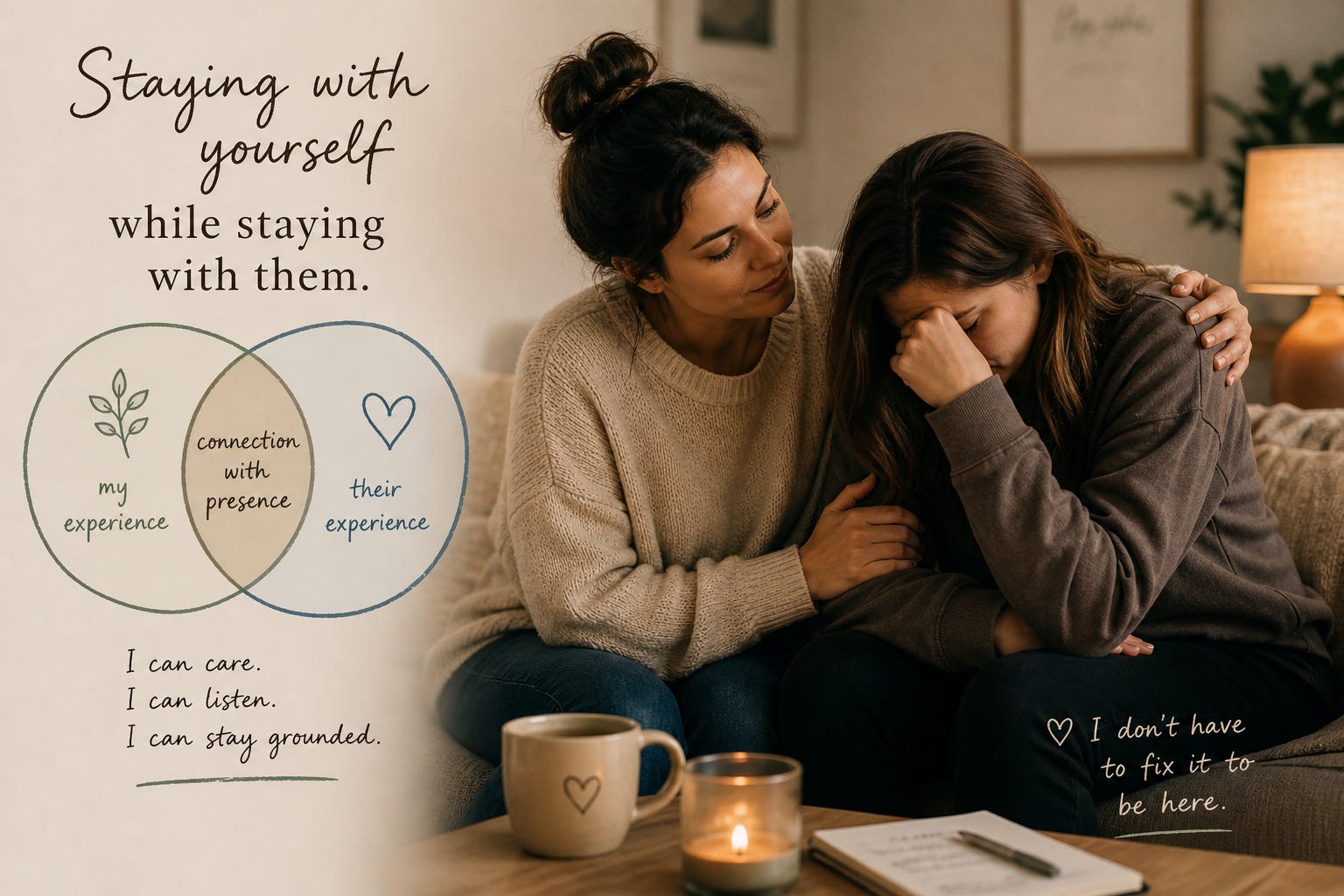
What I’m slowly learning is that there’s another way to be with each other.
A way that doesn’t require me to leave myself in order to stay connected to my loved ones.
A way that allows two things to be true at the same time:
You can be having a hard moment AND I can still feel steady, or even light.
Not because I don’t care, but because I do.
Differentiation is a word that can sound clinical, but the way I experience it is deeply human.
It’s the ability to stay connected to someone else… without abandoning my own internal experience.
Not “either/or,” but “both/and.”
I can see you.
I can feel with you.
I can care deeply about what you’re going through.
And I can also remain anchored in myself.
I’m starting to notice the difference in my body.
When I’m merged, everything tightens. There’s urgency, a subtle pressure to do something - to change the state of a loved one so I can feel okay again.
When I’m differentiated, there’s more space.
My feet feel a little more grounded and my breath is fuller. I can sit next to them, instead of inside what they’re feeling.
And from that place, something shifts in how I show up.
Instead of trying to fix, it sounds like:
“I can see this is really heavy right now.”
Instead of absorbing, it sounds like:
“I’m here with you.”
And instead of abandoning myself, I can stay connected to my own experience.
This matters more than I realized.
Because when I lose myself in someone else’s emotions, it might look like I’m being supportive… but what’s actually happening is something different.
Instead of offering steadiness, I’m adding more intensity to the moment.
Now there are two overwhelmed nervous systems in the room - two people caught in the same emotional current.
And even though it comes from love, it doesn’t actually create the kind of support I think it does.
But when I can stay connected to myself while being with someone else, something shifts.
There’s more space - more room for both of us to breathe.
I’m no longer trying to pull them out of what they’re feeling so I can feel okay again.
And I’m not getting swept away by it either.
I’m just… there, with them.
And what I’m starting to understand is this:
They don’t need me to take on their pain.
They don’t need me to become just as upset, or just as heavy, or just as overwhelmed.
What they need is someone who can be with them in it, someone who can sit beside them, stay present, and not disappear.
There’s something deeply regulating about that.
To be met by someone who isn’t trying to fix you and isn’t pulled under by you. But instead is simply there – steady, open, with you.
If this is something you’re noticing in your own life, I’ve put together a companion guide for paid subscribers where I walk through how to actually practice this in real time.
Inside, I’ll share:
How to tell what’s yours vs. what you’re absorbing
Simple ways to ground yourself in the moment
What to say (and what not to say) when someone you love is struggling
Real-life examples of what differentiation looks like in relationships and parenting
If you’ve ever felt the pull to take on someone else’s emotions—and want a way to stay connected without losing yourself—this will support you in building that skill, one moment at a time.